Reflections on Vancouver, British Columbia and other topics, related or not
Indigenous slavery
on the West Coast
As brutal as anywhere else, the practice was
essential to natives’ culture and economy
Greg Klein | May 18, 2026
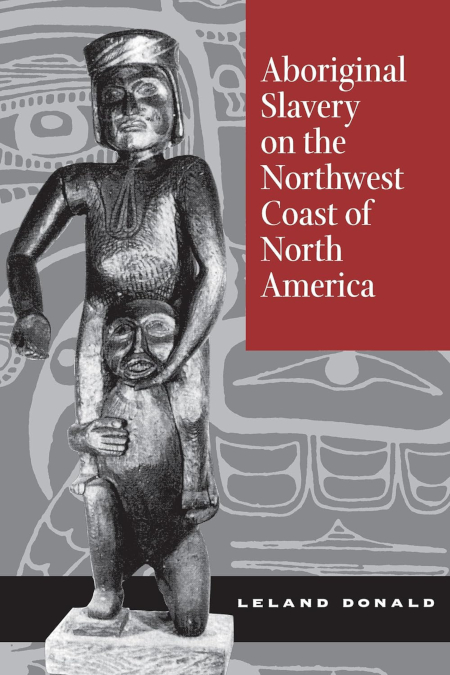
Anthropologist Leland Donald spent 15 years re-assessing previous
work with a critical eye towards conventional perspectives.
Downplayed or excused by some anthropologists, slavery was rife among virtually all aboriginal groups on the Pacific Northwest Coast. Slaves constituted property that could be traded, abused or killed, but their labour and degradation were essential to natives’ food supply as well as their intensely status-conscious culture.
Early Russian, Spanish and British explorers and traders condemned the practice but lacked the power to stop it. Not until the late 19th century did Canada and the United States manage to enforce abolition. Only with reluctance did aboriginals give up a long tradition that, among other evils, allowed the murder of slaves.
A neglected subject
Limited previous research and a tendency to downplay the topic surprised Leland Donald, an anthropologist who originally specialized in African cultures. He says Enlightenment notions of the Noble Savage influenced earlier studies to take an overly sympathetic approach towards aboriginals that fostered a benign view of West Coast slavery—effectively sugar-coating the practice despite its extent, importance and violence. Also downplayed were headhunting, cannibalism and relentless warfare.
For many researchers, Franz Boas set the standard. Considered the father of American anthropology, he began his West Coast field work with repeated visits beginning in 1886. His strengths and weaknesses, Donald maintains, came to characterize other studies, as did Boas’ neglect of the native economy, the organization of work and the related topic of slavery.
Donald’s 1997 book doesn’t mention the already decades-long onset of political correctness, now known as woke and directing all aspects of society with devastating effects on scholarship.
The evidence was there all along
Donald’s 15-year re-assessment of nearly 800 historical and ethnographic sources led him to challenge the methodology and assumptions behind orthodox views about West Coast slavery. The ethnographic studies included observations and interviews, the latter often reporting recollections of early life and memories of what previous generations had said. Contemporary accounts came from explorers, other travellers, government officials, missionaries, traders, residents and others.
Donald’s subject area spans from Yakutat Bay on the northern Alaska Panhandle through present-day British Columbia to the mouth of the Columbia River on the Washington-Oregon border, and extends east to the Coast and Cascade ranges. For lack of pre-contact sources, his study period begins circa 1770 with Russian, Spanish and British accounts. It covers much of the 1800s but emphasizes the first third of that century.
Info was more plentiful for some communities than others, leading Donald to focus on several discontiguous groups within the region. But he maintains that the various coastal groups had enough overlapping traits to allow some generalizations.
Virtually all those groups practised slavery.
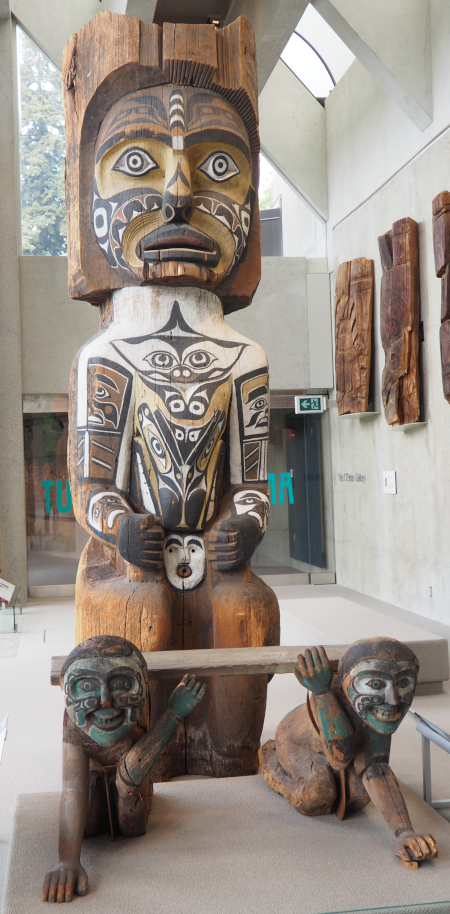
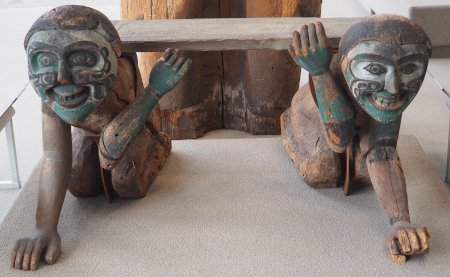
This Kwakwaka’wakw (Kwakiutl) house post from Quatsino on Vancouver
Island shows an elite “ancestor figure” with two kneeling slaves. The
slaves support a platform used as a seat by their owner’s family.
(Artist: George Nelson)
Slavery in context
Slavery was conducted by disparate peoples in other parts of the world including Africa (besides the trans-Atlantic trade) and the Middle East, as well as by Europeans in the New World.
On the North American Pacific, Russians held Aleuts in virtual slavery, Donald points out. A few American ships bought or caught native slaves for re-sale. Some Hudson’s Bay Company men had native wives who owned slaves.
Initially unaware, the HBC during one period formed part of a three-way trade involving northern natives who traded with inland natives, exchanging slaves for furs which were then exchanged for the HBC’s manufactured goods.
But Europe’s abolitionist movement had been gaining influence. Britain ended slavery in stages beginning with its 1807 ban on the trans-Atlantic trade. Despite European condemnation Northwest slavery continued into the late 19th century, showing limits to non-native authority. Abolition also owed its eventual success to Canadian and American suppression of endemic native warfare, the major source of slaves.
A class-ridden, status-conscious, violent and often macabre society
Just about all observers in the Northwest identified kinship groups (sometimes loosely called “tribes” or “bands”) featuring a three-part social strata of “chiefs” or titleholders, commoners and slaves. The distinction between the first two was strong, but the greatest chasm separated free people from slaves.
Titleholders’ (usually hereditary) names designated rank and exclusive rights to, for example, certain material wealth, specific resources and resource locations (like prime fishing areas), and non-material but high-status possessions like the exclusive use and expression of certain songs, dances, myths and rituals. Titleholders could also claim spiritual power that commoners feared. Their material wealth was often considered a sign of favour by the spirits.
With some exceptions among commoners, titleholders were the usual slave-owners. A kin group might collectively own slaves but they were controlled by titleholders. Slaves were the most valuable property and, as such, vital to their owners’ status. All that wealth, privilege and ritual authority were essential to honour, far outweighing personal qualities.
Titleholders directed the work of commoners, who carried out tasks beneath titleholder dignity. Slaves got the most arduous drudgery. Labour was strictly divided by sex. Male commoners contemptuously shunned women’s work but male slaves could take part.
Freedom from work, Donald writes, allowed time for elite figures to do “other things” including “nothing.” Sloth was a matter of great personal pride.
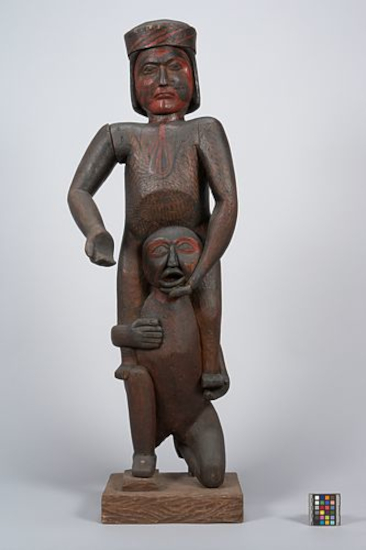
Again contrasting power with abject servitude, the UBC Museum of
Anthropology describes this carving as a “chief carried on the back
of a slave.” (Artist: Anonymous Kwakwaka’wakw carver)
A significant minority of men, especially titleholders, practised polygamy. But a titleholder’s status could be determined more by his number of slaves than wives. One Chinook titleholder had 10 wives and 18 slaves but, surprisingly, only four children.
Potlatches and other ceremonies turned status into a spectacle. The titleholder host would invite titleholders from other kin groups to a massive feast where he’d flaunt his wealth through extravagant gifts and destruction of property.
“Property” included slaves. Their murder confirmed not only the owner’s wealth, but also his power over life and death.
Feasts required reciprocal events by the guests, who competed with each other for ever-greater demonstrations of wealth and status.
Apart from slave murder, potlatches could erupt in violence, an ongoing danger whenever more than one kin group was present, even if they lived in the same community.
Warfare was endemic. Mostly consisting of surprise dawn attacks, the strategy was to kill and loot as much as possible before a quick retreat. Motives included avenging a death or killing titleholders for their territory or rights, but mostly taking captives, preferably women and children. War supplied most of the Northwest slave population.
Scalping wasn’t common but some groups practised headhunting.
Cannibalism also prevailed in a number of groups. The “right” to eat people could come to titleholders through inheritance or a marriage transaction. The fare could consist of a not-so recent corpse or a chunk out of a living person, but usually came from purposely killed slaves.
The meal might have been less a ritual than a “gastronomic or even epicurean” delight. The esteemed Nootka Sound chief Maquinna reportedly fattened up at least 11 young children to eat. (The practice has ended but even now, a band member told me, at least one Vancouver Island Kwakwaka’wakw community considers its cannibal society the most prestigious of the group’s still-active secret societies.)
Slavery supply met demand mostly through war
Indeed, slave-raiding was the most common motive for war. Enslaved titleholders might get ransomed by wealthy kin, but the price was exorbitant. Other captives had little chance. Slaves’ children were born into slavery. Commoners could be enslaved by their own group for certain crimes. Slaves could be received to settle disputes or as potlatch gifts (if they weren’t “destroyed”).
Slaves were usually the most valuable trade items. But the most common source came from captives of war.
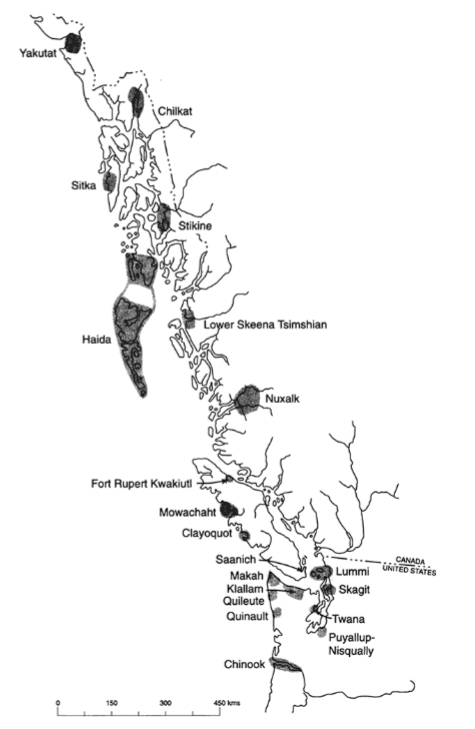
A map shows Donald’s subject area and the discontiguous
groups that had received the most research.
Slavery was essential to the Northwest indigenous culture and economy
As in the antebellum American South, elites of the Northwest “built their lives on slavery.” Commoners could benefit too, with any trickle-down effect of titleholders’ wealth and prestige.
Nearly all Northwest communities took part. Estimated slave populations varied from 1% to 2% of some communities to 30% or 40% of others, but commonly represented about 15% to 25%. Maquinna reportedly held about 50 slaves. Other titleholders in his Mowachaht community owned up to 12 slaves each. One Sitka leader held about 40. Even into the 1880s two other Alaskans owned 20 each.
The cycle of potlatches and other feasts, ceremonies of vital cultural, economic and spiritual importance, relied on slavery. Slave labour helped build the surplus of wealth for feasting and giveaways. To flaunt their riches, hosts presented guests with lavish gifts that could include slaves, possessions of the highest status. Or, to flaunt both wealth and power, hosts could kill slaves as part of the ceremony. A successful feast, with its abundance of food, extravagant presents and wanton destruction, was necessary for any titleholder to validate his position. Guests, meanwhile, held reciprocal obligations, pressured to out-perform the last binge with ever-more slaves and slave-raiding.
Slave labour could also prove essential to winter survival. Salmon provided the most important food for Northwest natives, but its abundance was limited to certain locations at certain times of year. Men fished while women got the more lengthy and labour-intensive work—scorned by free men—of cleaning, preserving and packing the fish. Male slaves, not considered men, were often necessary to help women prepare the winter food supply.
Slaves also performed the most menial drudgery, allowing commoners easier work and granting titleholders more time for sloth. “Only slaves made it possible for titleholders—the exemplars of Northwest Coast culture—to live and act as titleholders.”
A “life of misery” with ever-present danger of death
Northwest slaves were chattel slaves by any definition and by any comparison with slave-owning societies like Classical Greece and Rome, the Caribbean, the American South and 18th century Africa.
Unless born into slavery, they became slaves as captives of war. They slept in the coldest, most exposed part of a house, carried out the heaviest labour and faced arbitrary violence ranging from angry beatings to ritual murder.
Female slaves could work as servants for the owner’s wives and daughters. Elite men and women could pimp female slaves to non-native communities, with each titleholder/pimp controlling several involuntary prostitutes at a time.
In some cases slave mothers killed their newborns to save them from a life of misery.
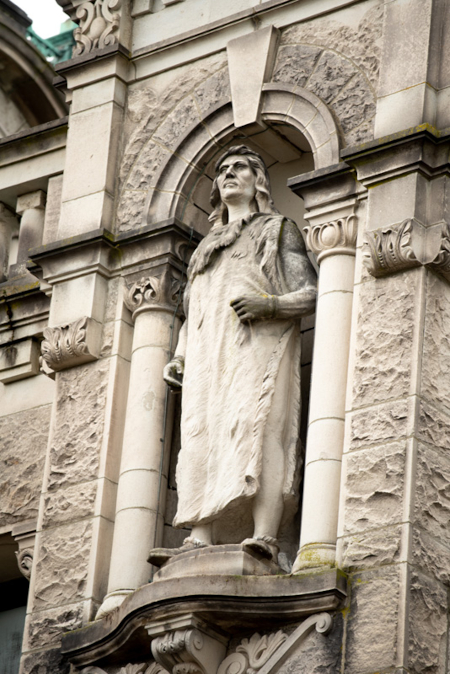
A statue of Maquinna stands in the British Columbia legislative building.
His name graces at least two schools, a provincial park and numerous other
place names in B.C. Possibly the most highly honoured aboriginal in the
province’s history, he led a group that slaughtered and beheaded 25 sailors
over a perceived slight. He was also one of the biggest slave owners on the
19th century Northwest Coast as well as a notorious cannibal.
Murder remained a very high risk. Donald mentions one feast that began with four slaves getting strangled. Besides potlatches, ritual killings occurred at events marking a new house or totem pole, or at a ceremony for a name-taking, a whale hunt (off the West Coast of Vancouver Island) or accession to shaman status. Titleholder funerals commonly included killing one or more slaves, as many as 12 in one example, to act as servants in the next life. An errant slave might get tied up and cast adrift to starve at sea. Titleholder quarrels might be resolved with each party killing a slave. Or an owner might kill slaves to assuage his wounded honour over an incident not involving the slaves. Slaves could be burned alive.
Ritual murder gave slave owners a “double payoff”—status derived from destruction of “property” and power from taking someone’s life.
Crucial to Northwest indigenous culture, ritual slayings continued into the 1870s and occasionally the 1880s. It was only under Canadian and American pressure, and with great native reluctance, that ritual slave murder ended.
Shame afflicted slave descendants at least into the 1970s
The stigma was so strong that escaped slaves were held in contempt even by their own kin.
Some Chinook free mothers killed their newborns simply out of fear that the child would be mistaken for a slave. That could happen if a white father objected to cranial deformation, the practice of binding an infant’s head to flatten the skull. Slave children rarely got the treatment, so in some regions a normally shaped head could suggest slave status. That mere perception was a fate worse than a baby’s death, according to some mothers.
(Beyond the scope of Donald’s book but still noteworthy was the widespread practice of female infanticide among Canadian Inuit at least up to the late 1920s. The purpose was population control in a Stone Age economy.)
A titleholder might marry a high-ranking woman from another kin group only to humiliate her relatives by selling her into slavery. According to Donald, “Such an event was part of the complex struggles for power, prestige, and influence that went on continuously.”
Male slaves weren’t considered men, could be assigned to disdained but essential “women’s work,” and could be given women’s names. Female slaves could be forced into prostitution.
Dead slaves weren’t afforded the same funeral practices of free people. Typically, their bodies were dumped in the sea.
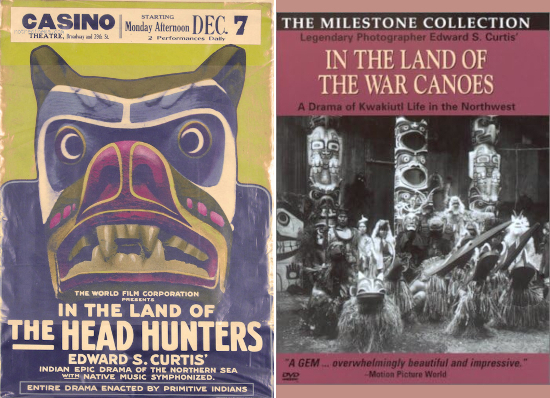
In the Land of the Head Hunters was a 1914 fictional movie created
by Edward S. Curtis, an American photographer and amateur ethnologist,
and his Kwakwaka’wakw assistant George Hunt. The film was re-released
in 1974 under the softened name In the Land of the War Canoes.
“Slave” was a serious insult well into the 20th century. Calling out a descendant could exclude the person from political or social involvement, wreck a marriage and, in one example, provoke murder. As an anthropologist wrote in the 1940s, “No amount of personal effort or intrinsic worth has overcome that taint of heredity.”
At least into the 1970s one B.C. reserve segregated slave descendants from the main village and allowed them fewer rights and less social interaction, Donald states. “They might attend a band meeting, but if any of them spoke, others reminded them of their descent ‘from the slaves’ and they were stopped from speaking further.”
And elsewhere...
Donald believes the same theoretical dispositions that downplayed Northwest slavery might affect studies of other North American aboriginals. Not acknowledged by Donald, that bias preceded (and might be an antecedent of) the political correctness that prevailed for about a quarter-century before his book’s 1997 publication. That year predates the all-out victory of woke ideology and its impact on scholarship.