
Reflections on Vancouver, British Columbia and other topics, related or not
Weak men,
wackjob women
and demographic disaster
Lionel Shriver’s A Better Life
updates The Camp of the Saints
Greg Klein | July 31, 2026
The pitifully oppressed arrive in Ceuta, Spain. At the time
of this post, it’s the humanitarian heartbreak du jour.
This middle class family becomes a metaphor for the U.S. and the rest of the West as dangerous opportunists take advantage of incredibly naive hosts. The only dissenter, the lone male among them, finds his apathetic lifestyle inadequate training for talking sense to his mother and sisters, let alone dealing with a permanent home invasion. Events shatter his carefully crafted cocoon in a story that focuses as much on his belated coming of age as his society’s collapse.
Lionel Shriver’s latest extends the oeuvre of an exceptionally talented writer who’s actually aware of life outside the Enlightened’s little world. Some of her previous novels have dealt with a teenaged mass murderer (We Need To Talk About Kevin), economic and societal breakdown (The Mandibles: A Family, 2029-2047) and ideological hysteria (Mania). A Better Life surpasses all of these for its characterization in a story replete with painfully tragic irony. Nico, a withdrawn mid-20s nonentity and the story’s sad excuse for a hero, stands out as the best creation yet from a woman remarkably good at depicting men.
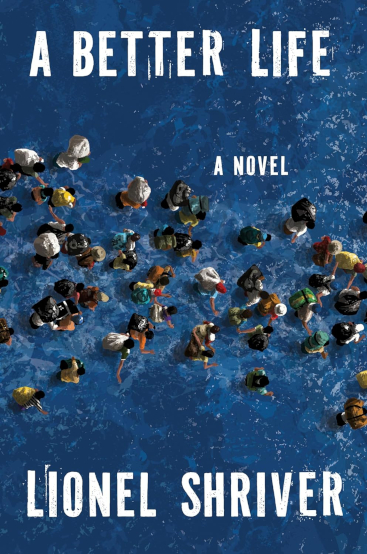
The story’s set during Joe Biden’s “presidency,” although Shriver’s a surprising agnostic in the great American (and therefore Canadian) sectarian conflict between Democrats and Republicans. New York City has instituted the Big Apple, Big Heart program to house Third World arrivals with volunteer citizens. Shriver bases that fictional campaign on an actual 2023 proposal by the mayor. “All other news stories, figures, and details, to the best of my ability,” Shriver states, “hew to reality.”
The reality is stark, nightmarish. Dramatic events centre around Honduran assholism in a fine old Queen Anne house that had been a model of middle American prosperity and dignity. Meanwhile expository sections, and often expository dialogue (common with Shriver, who certainly can be didactic), spell out, describe, itemize the enormity of an obviously unsustainable and insanely destructive invasion.

Jean Raspail’s 1973 novel foresaw the almost
unopposed Third World invasion of Europe.
It’s an invasion made possible by government policy and fashionable ideology along with the UN, rich charities and tax-funded NGOs. Operating huge camps along a migrant superhighway from South America to the U.S., the groups provide bus service, “food, water, medical care, clothing, provisions for the road, and rest for the weary. Cash. New phones. Legal advice. Maps of established routes north. These outfits are veritable travel agencies. It’s an industry. The atmosphere is carnival-like,” one (male) witness recounts. The network flows “not just from Venezuela and Brazil, but from China, Mali, Turkmenistan, you name it.”
American border agents accept their persecution stories without evidence. With no ID, arrivals get herded onto commercial flights for multicultural dispersal throughout the country:
“Ten million illegal immigrants tossed to the interior during this administration—and that was only the people the Border Patrol knew about.”
Once dispersed, benefits pile up, far surpassing anything Americans, even black Americans, qualify for. As another (male) dissenter says, “This whole flood over the border is predatory… it’s not an entreaty. It’s a shakedown.”
As such, it’s taken not with gratitude but contempt. Nico’s Honduran home invaders love to rub that in though word and deed. Their derision extends to all aspects of liberal society including law enforcement, the latter joke made further hilarious by the criminal invaders’ anonymity.
But all that’s excused, rationalized and at times praised by Nico’s mother Gloria. She exudes sanctity through involvement and never-ending proclamations backing all the Enlightened causes—even her professed white guilt constitutes “guilt as display, guilt as moral one-upmanship.” Headstrong to the men in her family, her kryptonite was race. She’d always defer to people of colour. Nico’s objections to months of in-house barbarity provoke her to call him a sociopath. And even worse—“simply not a nice person.”
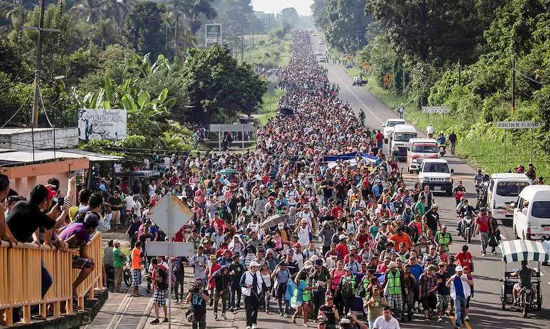
The men—almost entirely men, despite MSM claims—
march on foot when free buses aren’t available.
Well-funded groups provide lots of support en route.
Nico’s sister Vanessa amounts to little more than a spoiled ball of fluff, much like her yappy dog. His sister Palermo, on the other hand, undergoes true adversity that distinguishes her from these stereotypical white ladies. Yet she too rejects all evidence contrary to the conventional account of saintly oppressed migrants.
The male-female chasm doesn’t divide just this family. Their friends, film-making couple Vernon and Colleen, work on a migration documentary. Vernon wants it based on what they’d researched and seen first-hand. Colleen wants typical MSM bullshit. They never finish the film.
A more complex woman is Martine, the “queen of ambiguity” according to Nico, who nevertheless believes he can see right through the “lying sack of shit.” Other characters include Martine’s fellow Hondurans and Nico’s dad Carlin, not normally a man of action but neither a non-achieving non-participant like Nico and so many of his peers.
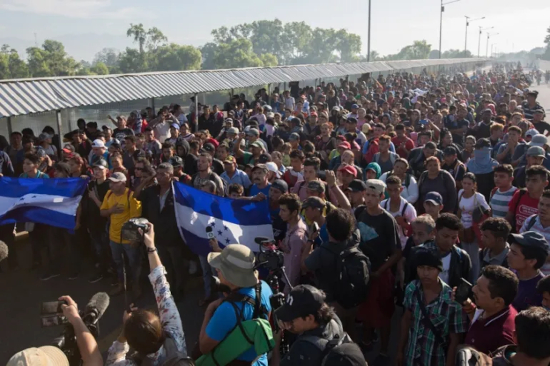
Overwhelmingly male hordes march towards their land of opportunism.
Ah, Nico. An ineffectual live-with-divorced-mom dropout who’s done nothing since graduating from university five years earlier, he cultivates a life of non-involvement, evading all forms of responsibility or commitment. “In Buddhism,” he says, “having no desires is nirvana.”
Responding to Martine’s scornful debating points, he struggles to express his thoughts: that his society resulted from diligence, social cooperation and innovation over many years; that bad countries result from tyranny, social indiscipline and corruption. It’s from those countries that millions arrive to cash in on civilizational benefits their forebears hadn’t amassed.
A short fling does challenge “the proposition that what he’d been feeling for the last five years had truly qualified as contentment.” But his placid bubble finally pops under Third World barbarity that provokes emotions and personal conflicts for which he’s never been prepared. “The psychic turbulence of this week confirmed that the experience of responsibility was altogether odious, and he’d been hitherto wise to avoid assuming such a millstone by any means necessary.”
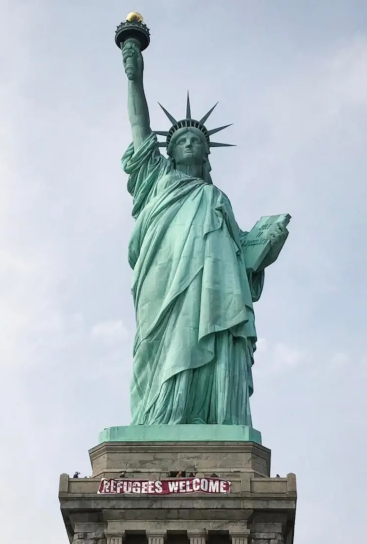
From teeming shore to teeming shore,
Third World refuse overwhelms the West.
But act he must, especially for his mother’s safety. Yet at one point his budding manhood is reduced to childish sobbing on Gloria’s white-mother-to-son cruelty, behaviour intensified by her unrelenting compassion for the enemy within.
Eventually Gloria reverses her opinion of Nico by implying confidence in his ability to protect her. And again he wavers under the responsibility complicating his life.
Further aggravating his condition are insults, including Hondurans treating him like a servile woman, as they treat all women including Nico’s submissive-to-non-whites mother and sisters. The need to act, the willingness of previous generations to do so, makes him wonder: “Maybe there was still something to be said for men who embraced those trite markers of masculinity from which Nico had distanced himself since puberty: aggression, strength, confidence, anger, action, and violence capable of being channeled for good as well as ill.”
Shriver’s story eventually takes on aspects of a thriller, but with some obvious possible outcomes. So even if both the climax and anti-climax fail to surprise, the denouement doesn’t. Shriver holds out hope for Nico as an individual, something even of a man, despite his society’s loss to Third World squalor and violence.
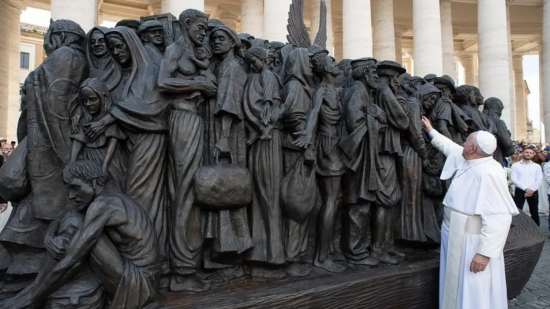
In St. Peter’s Square, Pope Francis admires a Canadian’s
false portrayal of “refugees” as men, women and children from
Europe and elsewhere bearing expressions of suffering and nobility.
And a truly final note: The loss is Western society, not just American. Earlier in the story, Vernon tells friends that Africa’s population is “certain to rise from 1.4 billion this year to 2.5 billion by midcentury and almost guaranteed to reach four billion or more by 2100. Way before then, he said, the pressure on European borders from their neighbors to the south would be fantastic; as for all the overloaded dinghies crossing the Mediterranean now, ‘they haven’t seen anything yet.’
“…The obvious, ahem, racial element was bound to make these mass flotillas, ‘shall we say, awkward,’ he noted, which alone would make muscular policy responses politically untenable before total reverse colonization was a fait accompli.”
Well before he’d got to that point, Gloria had stalked out of the room.