
Reflections on Vancouver, British Columbia and other topics, related or not
Grave Error, Dead Wrong,
Making A Killing
It’s Canada that’s dying,
due in part to the reconciliation scam
Greg Klein | December 17, 2025
Making A Killing: Watch it while you can.

Read Grave Error and Dead Wrong too. But keep in mind the film’s
creators and books’ contributors would reject this site’s perspective.
In a society convulsed with emotional confusion, OneBC was probably doomed from the outset. So while the Enlightened dance on its unmarked grave, the most troubling question might concern the party’s documentary. Will the remnant of OneBC try to pull Making A Killing out of circulation?
The film represents the work of two people with factions now at war. It was written and directed by party staffer Tim Thielmann but narrated by MLA Dallas Brodie, who appears multiple times beginning with a personal campaign-style intro. They’re now rivals trading counter-accusations. The film gives little attention to OneBC’s only other MLA, Tara Armstrong. She’s allied with Thielmann. (Update: Brodie has regained party leadership; Thielmann has resigned, as has Armstrong who now sits as an independent.)
Released about the same time as Killing was Dead Wrong, a follow-up book to Grave Error, both edited by C.P. Champion and Tom Flanagan. The book and film should come at an auspicious time, now that B.C. has (predictably) given itself away. Despite mainstream silence, the film’s viewership has been something of a sensation, especially after Elon Musk retweeted a link. The book might do well too, but only by book standards. Reading is almost as rare as rationality.
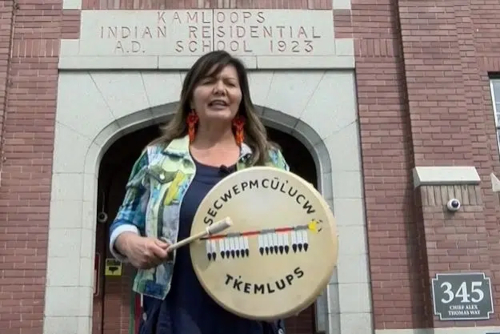
No one in the mainstream dares ask Kamloops chief Rosanne Casimir
for evidence about 215 hidden graves—or what the band did with
several million taxpayers’ dollars given to provide evidence.
Her band’s land claim covers the entire city of Kamloops.
Even so, Grave Error might have caused a shift in mainstream discourse as the terms “mass graves” and “confirmed graves” decline in usage, generally replaced with “potential graves.” That’s still grossly misleading, but shows a modicum of moderation in the emotional bullshit. Drawing partly on Grave Error’s exposés, Making A Killing could have greater impact.
The film is easier to follow than either of the books, which comprise disparate chapters by separate authors, all vital material but not always conducive to continuity. The film, troubling as the subject is, manages to build to an encouraging finale. (Thielmann and Brodie made a great team, RIP.)
But while the film gives the impression all this madness can be reversed, the book’s unintentionally discouraging. The account of mass graves hysteria at an Abbotsford high school can only instill despair about an upcoming generation of emotionally disturbed fanatics. The Quesnel furor shows a smallish community poisoned by aggressive guilt-mongering. The same with Powell River, although more people there seem to have retained some sanity.
Much more than the books, the film addresses “reconciliation” profiteering through tremendous payouts, land transfers, control over resources and tax-subsidized deals with big business. Where does the money go? Some of the natives in Vancouver’s drug-infested slums want to know.

The film doesn’t ask what happens when the six-tower Kitsilano
mega-project’s business partners, 6,000 tenants and 12,000 condo
“owners” find out natives aren’t subject to contract law.
Among the deals is the Squamish band’s Kitsilano ultra-high-density real estate project, funded by the federal government and developers who used “reconciliation” to evade zoning and building regulations.
Dead Wrong adds additional evidence to Grave Error’s residential school reality, and also tears apart some recent propaganda like Sugarcane, a National Geographic-sponsored, Oscar-nominated movie that’s shown to be rife with factual errors and contradictions. Yet the film’s “bound to be inflicted upon generations of defenceless Canadian schoolchildren, as has happened with the Chaney Wenjack story... also filled with inaccuracies” pushed by a minor rock thingie/activist. A 2024 book The Knowing (sic) got glowing reviews “everywhere in the Canadian legacy media... despite being packed with misinformation.” Outside one National Post column, Grave Error got no MSM mention—not until a localized panic in Quesnel provided media with denunciations of “hate” and “denialism” in a book that’s “very, very, very traumatizing.”
Of course PC/woke will always restrict factual info and honest discussion. As for OneBC, it’s likely finished. Brodie and Armstrong were elected as B.C. Conservatives. Some of their voters might not have realized these two actually intended to take a stand. Such is the temper of our times that their termination might come before the next election, in a manner the Enlightened describe as “largely peaceful” and “regrettable but understandable.”
Other voters, former home-owners who are no longer home-owners in (so far) Richmond, Pender Harbour and Haida Gwaii, might get bought off by the NDP. Just a few billion or so, to start with, added to the province’s record debt.
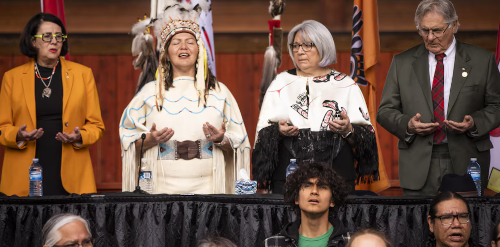
Along with “land acknowledgments,” participation in pagan
rites is becoming compulsory in schools and some public events.
B.C. Conservative leadership contender Caroline Elliot expresses some common sense on native issues, but not without excessive sympathy that might portend excessive concessions. Moreover her Slightly Different Party colleagues have no principles other than their pay, perks and pension plan. As B.C. Liberals/United before joining the Conservatives, they opposed none of the NDP’s revolutionary agenda.
The books and film do ask how Canada can function as native power overrides rule of law and democratic governance. But there are other questions which the books and film would disavow.
How many native leaders show even average intelligence? Which ones are they? What does it take to get along with native leaders?
It’s worth noting that Canada’s most powerful ethnic group was a passive recipient of its power. Notwithstanding two generations of “lawyers” churned out by dumbed-down native-only university programs, aboriginals played little or no role in the declarations, rulings, policies and laws issued by the UN, parliament, legislatures and courts. UNDRIP, the “genocide” declaration and DRIPA, aboriginal title and aboriginal sovereignty, resources control and the native veto, Gladue, the entitlements, sinecures, money and all the rest owe their existence to non-natives, mostly whites.
It even took a white junior academic to proclaim the facile lie that triggered the unmarked/hidden/mass graves hysteria that continues to expand and intensify native power.
This is speculative: That turmoil might have been planned and orchestrated by a coterie of well-organized, well-connected non-natives who learned from a similarly orchestrated uproar following the Minneapolis martyrdom. Otherwise there’s something uncanny about the rapid, extreme, society-wide upheaval in either instance, not to mention both cases.
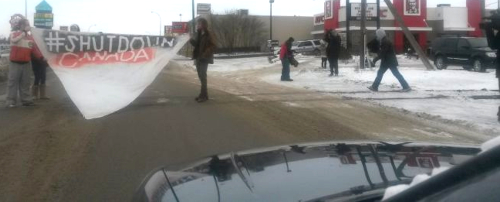
With relative immunity from criminal law, natives
need very few people to block a highway. Backed by
well-organized advisors, they could shut down the country.
Should such a coterie exist, it might take advantage of natives’ near-immunity to criminal law, along with extensive national and international media sympathy. Instead of an indolent roadblock here and a slothful blockade there, a well-organized campaign could shut down Canada.
Highly speculative indeed. But the response might be alarming if premier David Eby tries—or even pretends to try—to claw back what he’s given away.
And in a final note, the country’s overall response to the reconciliation con leads to one more racially charged question: Can’t white Canadians function better than this?